

To set up an online store in Ghana, choose a product niche and test whether potential customers show buying intent. Then create a clear product catalogue, configure payment and delivery options, and test the full checkout and security process before launch. An online store lets customers discover products and place orders digitally.
A website is more than a digital display. Its design should help shoppers understand what you offer, trust the information, and move smoothly from browsing to payment. A clear visual structure supports those decisions, while demand testing and a straightforward buying process help prepare the store for real customers.
This guide explains how to choose a focused niche, test demand before investing heavily in stock, and design a store around Ghanaian shoppers. You’ll learn how to organize product pages and navigation, set up payment and delivery flows, and test checkout and customer-data safeguards before launch. The goal is to start with evidence, clear design, and practical operating processes.
Key Takeaways
- Choose a focused product niche, then test interest with potential buyers before committing heavily to stock.
- Plan delivery options around customer locations, order handling, and the cost of getting products to buyers.
- Walk through the full shopping journey before launch, including payment, checkout, and secure handling of customer data.
- Use clear navigation and product pages to make shopping straightforward; professional store development can help bring the design and buying process together.
Choosing a product niche and validating demand
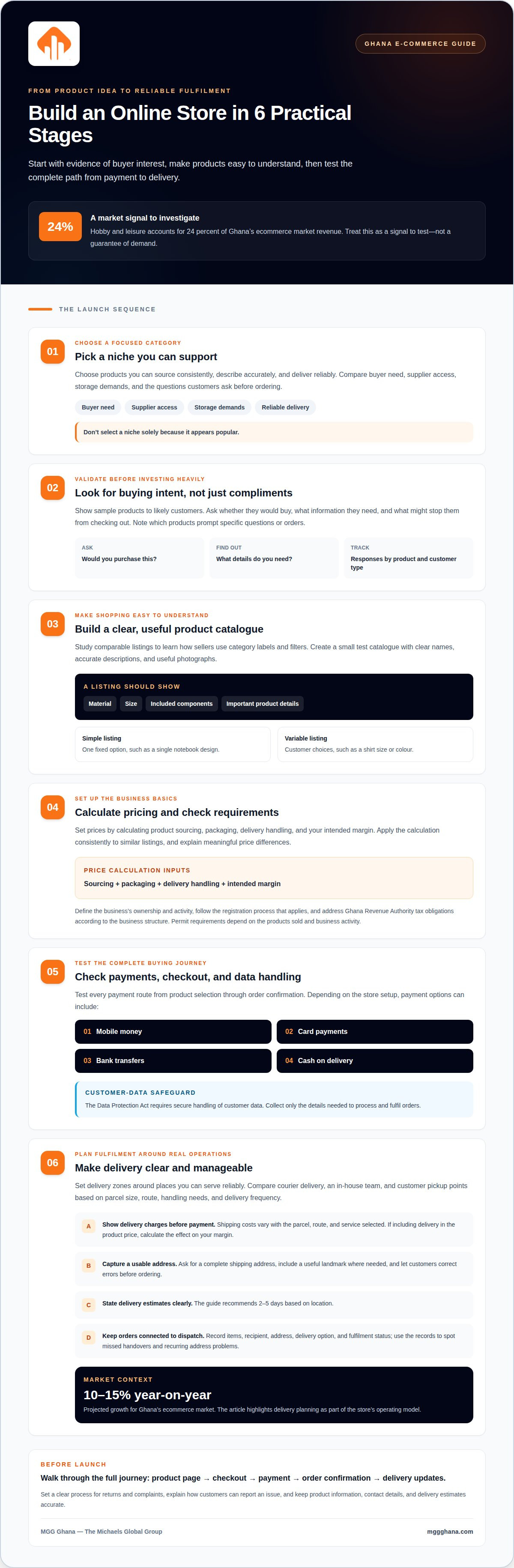
Start with a focused product category, test buyer interest, then prepare listings that answer practical shopping questions. In Ghana, hobby and leisure accounts for 24 percent of ecommerce market revenue, one signal to investigate rather than a guarantee of demand.
In Ghana, permit requirements depend on the products sold and the business activity. Identify the rules relevant to your goods before listing them. Having an online storefront does not settle product-specific licensing requirements.
-
Choose a Product Niche
Choose a category you can source consistently, describe accurately, and deliver reliably. Compare possible niches by buyer need, supplier access, storage demands, and the questions customers ask before ordering. For example, if you’re considering hobby supplies, focus on a clear group of related products rather than an unrelated catalogue. Don’t choose a niche solely because it appears popular.
-
Validate Product Demand
Test interest before buying substantial inventory: show sample products to likely customers, invite feedback, and note which items prompt specific questions or orders. Ask whether buyers would purchase each product, what information they need, and what might stop them from checking out. Positive reactions are useful, but distinguish general approval from specific buying intent. Track responses by product and customer type.
- Study product categories on online shopping sites and marketplaces to see how sellers organize comparable items. Note category labels, filters, and the details shoppers need to compare options. Then create a small test catalogue with clear product names, accurate descriptions, and useful photographs. Use consistent backgrounds and show important details, such as material, size, or included components, so customers can assess each listing.
- Set prices by calculating product sourcing, packaging, delivery handling, and your intended margin. Apply the calculation consistently to similar listings, and explain meaningful price differences. Use a simple product listing when there’s one fixed option, such as a single notebook design. Use a variable product listing when customers choose options, such as a shirt size or colour. Clear options help customers place accurate orders.
Why Start an Online Shop in Ghana Now?
Ghana’s ecommerce market is projected to grow by 10 to 15 percent year on year, making delivery planning part of a store’s operating model. Registration, tax obligations, delivery choices, and customer communication also shape a prepared launch.
To register an online store business in Ghana, define its ownership and activity, then follow the business registration process that applies. Address tax registration with the Ghana Revenue Authority according to the business structure and obligations.
The cost to build and run an online store depends on its scope and is provided after a quote request. Factors affecting the work include catalogue size, design requirements, payment and delivery features, hosting, and ongoing maintenance.
Set a clear policy for returns and complaints. Explain how customers can report an issue, how you assess products, and how you communicate refunds or replacements. Build trust with accurate product pages, visible contact details, clear delivery estimates, and timely order updates.
- Set delivery zones around the places you can serve reliably. For example, group destinations by locality or region, then assign a delivery option to each zone. This shows customers relevant choices at checkout and helps you plan fulfilment without promising coverage your operations cannot support.
- Compare courier delivery, an in-house team, and customer pickup points based on parcel size, route, handling needs, and delivery frequency. Shipping costs vary with these factors and the service selected. Show the applicable charge before payment, or include it in the product price only after calculating the effect on your margin.
- Ask customers to enter a complete shipping address, including a useful landmark where needed. Make address fields easy to understand, and provide a way to correct errors before an order is placed. State delivery estimates clearly; the guide recommends 2-5 days based on location.
- Connect orders, stock records, dispatch, and customer updates in your delivery process. A simple order log can record each item, recipient, address, delivery option, and fulfilment status. Review the records to spot missed handovers, recurring address problems, and routes that need adjustment.
- Plan selling and hosting together: product pages create expectations, while fulfilment determines whether those expectations are met. As revenue grows, review delivery zones and options using completed orders and customer feedback. Plan your online store setup around the buying and delivery journey.
First decide who owns the business and what it will do. Then complete the registration process that applies to its structure and activity. Address tax registration with the Ghana Revenue Authority in line with the business’s structure and obligations.
Register with the Ghana Revenue Authority according to your business structure and tax obligations. The applicable taxes depend on those factors.
Testing payments, checkout, and store security before launch
Test every payment route from product selection through order confirmation. Depending on the store setup, payment options can include mobile money, card payments, bank transfers, or cash on delivery.
Protect customer information throughout checkout. Ghana’s Data Protection Act requires online businesses to handle customer data securely, so collect only the details needed to process and fulfil orders.
-
Set Up Payment Methods
Choose payment methods that suit your customers and fulfilment process. Configure mobile money and card payments through an online payment gateway, and show other options, such as bank transfer or cash on delivery, where available. Make each method clear at checkout. Review transaction records and order notifications so staff can distinguish completed payments from pending orders.
Before adding payment options, consider how your customers prefer to pay. Mobile money use can vary across customer groups, so use buyer feedback and actual order patterns to guide your selection. Don’t list a payment option your team can’t reconcile or fulfil reliably.
-
Test Checkout and Transaction Security
Place a complete test order on both a phone and a computer. Check that product details, delivery choices, payment instructions, and final totals remain clear throughout checkout. Use the gateway’s test mode where available, and verify successful, declined, and interrupted transactions. Confirm that each outcome produces an accurate order status and customer message.
Review how checkout collects and protects names, contact details, and delivery addresses. Limit staff access to order information based on their responsibilities, and don’t send sensitive payment details through ordinary messages. Check that the store uses a secure connection and that customers can find a privacy notice before submitting their information.
Finally, review a completed test order from the customer’s perspective. The confirmation, payment status, and next steps should match. Fix unclear instructions or inconsistent records before launch, then repeat the test whenever you change payment settings, checkout fields, or gateway configuration.
Online store design
Design the store around the decisions shoppers need to make, not decorative effects. A clear layout guides visitors from product discovery to checkout without unnecessary distractions.
- Map the shopping journey before choosing a layout. To decide how to set up an online store Ghana shoppers can navigate, organize the home page around product categories and make search, contact details, and delivery information easy to find. Keep the route from category to product page to checkout consistent. Visitors arriving from a social post should quickly understand what the store sells.
- Build navigation around the words customers use to describe what they want. Group related items under concise labels, such as kitchen tools, rather than scattering them across menus. Keep the main navigation focused, and place policies and support details where shoppers can find them without interrupting browsing.
- Choose a restrained visual system. Use 2-3 main colors consistently across buttons, headings, and page accents. Set readable text sizes and leave space between sections, especially on phone screens. Make important actions, such as adding an item to a cart, appear clearly without competing with secondary links.
- Structure each product page to answer practical questions in a logical order. Show the product name, price, available options, and key details before supporting information. For example, a clothing listing should clearly distinguish sizes and explain the fit. Make buttons and option selectors easy to use on smaller screens, where many visitors may arrive from mobile.
- Review the design on a phone and desktop before launch. Check that menus open correctly, text stays readable, and product details remain visible without awkward scrolling. Plan how to set up an online store Ghana businesses can maintain by choosing a clear domain, consistent branding, and matching page styles. Build a professionally designed online store with a customer journey that is easy to follow.
MGG Ghana - The Michaels Global Group: Professional online store development
MGG Ghana, The Michaels Global Group, helps businesses turn a validated product idea into a working online store through professional online store development. When you’re ready to bring your product catalogue, payment journey, and store design together, MGG Ghana can build them into a structured digital experience.
Website design and development can create clear paths from product discovery to checkout, while branding and graphic design help establish a consistent identity across store pages. For businesses with more complex operational needs, web applications and business systems can support connected processes. The right starting point depends on your products, customer journey, and the functions your store needs.
Share your store goals and requirements with MGG Ghana - The Michaels Global Group, or visit mggghana.com to take the next step.
Build a store that can grow with your customers
Launch is the beginning of learning, not a reason to stop improving. Decide how you’ll review customer questions, order patterns, and delivery issues, then use what you learn to refine the store. For example, repeated questions about a product may show that its page needs clearer information.
If you’re considering how to set up an online store in Ghana, turn your preparation into a steady operating routine. Make decisions using customer feedback, improve one part of the experience at a time, and expand the catalogue when your operations can support it.
When you’re ready to shape your next steps with a digital development partner, contact MGG Ghana - The Michaels Global Group. A considered foundation gives your business room to learn, adapt, and build lasting capability.
Frequently Asked Questions
What Is an Online Store and How Does It Work?
An online store lets customers browse products and place orders through a website. A shopper selects an item, submits an order, and receives confirmation while the business records the purchase. The seller then prepares fulfilment and updates the order status. Connecting order records to stock tracking helps prevent selling an item that’s no longer available.
Which ecommerce platforms work best for Ghanaian businesses and accept local payments?
WooCommerce and hosted ecommerce platforms are options, but the right fit depends on your catalogue, technical capacity, and payment gateway compatibility. WooCommerce holds 33-39 percent of the global ecommerce platform market share. Before choosing, map your required checkout methods to integrations available for the platform, then assess how easily staff can manage stock, product options, and order records.
How can a Ghana online store accept Mobile Money, cards, and bank transfers?
Connect a payment gateway that supports your intended methods, then configure those options in the store checkout. For bank transfers, give clear instructions on how customers should identify their orders. During reconciliation, match each gateway transaction reference to the corresponding store order. This helps staff resolve payment questions without relying only on screenshots or customer messages.
Which courier and delivery services cover Ghana, and what are typical shipping costs?
Delivery coverage varies by courier network, address, parcel size, and service option. Compare courier delivery, an in-house team, and customer pickup against the destinations your store serves. Shipping charges depend on factors such as parcel dimensions, weight, route, and delivery speed, so calculate them using the actual order details. Record delivery outcomes to identify routes or parcel types that need different handling.
What are the steps to register an online store business in Ghana?
Define the business’s ownership and activity, then follow the registration process that applies to its structure and activities. Address tax registration with the Ghana Revenue Authority according to the business’s structure and obligations.
