

A well-planned online store setup in Ghana starts with a mobile-friendly shop, a clear product catalogue, secure checkout and Mobile Money payments. An online store can accept orders at any time, but customers also need to know what they will pay and how their purchases will reach them.
It is natural to focus first on choosing products and getting the website online. But pricing, payment arrangements and delivery options matter just as much: they determine whether each sale works for your business and whether customers understand what to expect.
This guide explains how an online store works and the practical decisions involved in launching one. You will learn how to build a catalogue, account for costs when setting prices, organise domestic delivery and plan for international orders. You will also find ways to make the store easier to use and manage orders consistently as sales grow.
Key Takeaways
- Map the customer journey from browsing and payment to order confirmation so each step is clear and easy to manage.
- Set delivery options for local and international buyers, and communicate expected timing and shipping charges before checkout.
- Build prices around product costs, operating expenses and delivery so each sale supports a workable business plan.
- Organize product details and images into a catalogue that helps customers make informed choices and supports efficient order handling.
Delivery partners, shipping options, and costs
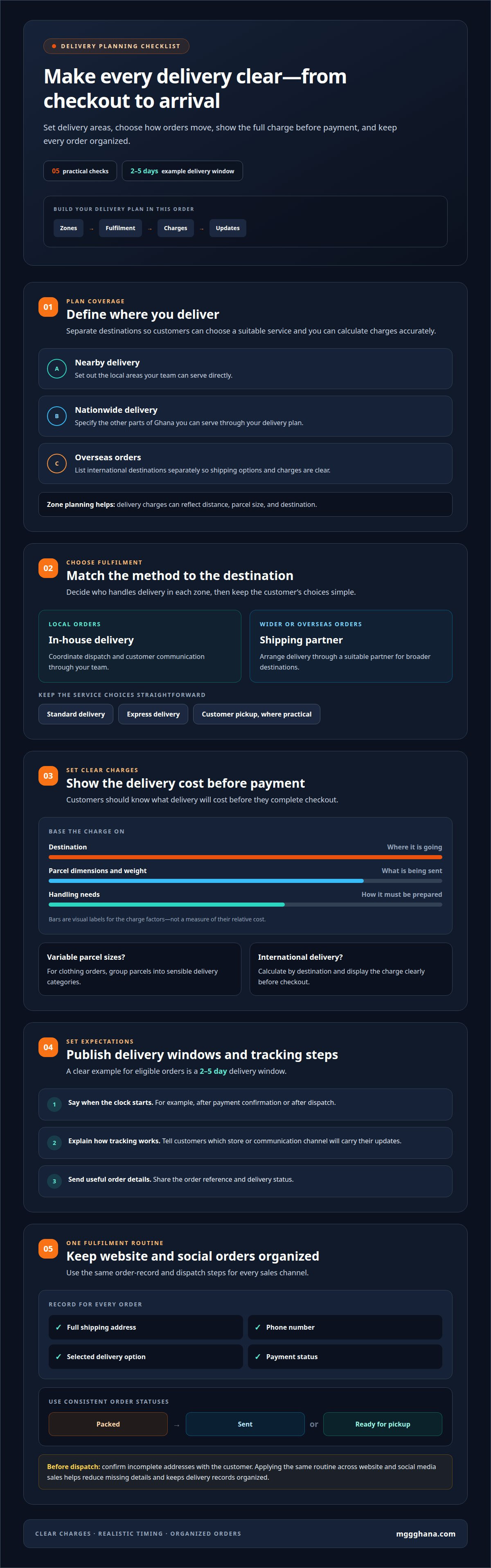
- Define delivery zones before opening checkout. Separate the destinations you can serve locally from other parts of Ghana and international destinations. For example, offer options for nearby delivery, nationwide delivery and overseas orders. This helps customers choose the right service and lets you calculate charges based on distance, parcel size and destination.
- Choose a fulfilment method for each zone. For local orders, plan in-house delivery so your team can coordinate dispatch and customer communication. For wider domestic or international destinations, arrange delivery through a suitable shipping partner. Keep the choices simple, such as standard delivery, express delivery or customer pickup where practical.
- Set charges customers can understand. Calculate delivery charges using the destination, parcel dimensions, weight and handling needs. Show the charge before payment so customers are not surprised after checkout. If clothing orders vary in parcel size, group them into sensible delivery categories. For international orders, calculate charges by destination and display them clearly.
- Publish realistic delivery windows and tracking steps. An example delivery window of 2-5 days gives customers a clear expectation for eligible orders. State when that window begins, such as after payment confirmation or dispatch. Explain how customers receive tracking updates, and send the order reference and delivery status through the store or communication channel used for the purchase.
- Connect social media sales to one fulfilment routine. Record the customer’s full shipping address, phone number, selected delivery option and payment status for every order. Confirm incomplete addresses before dispatch, then mark orders as packed, sent or ready for pickup. Using the same steps for website and social media sales reduces missing details and keeps delivery records organised.
What Is an Online Store and How Does It Work?
A Ghanaian online store displays products, accepts orders and coordinates payment. Plan checkout alongside the store design so customers can move clearly from product selection to payment.
Before launch, register the business through Ghana’s applicable process. Understand its tax responsibilities and publish clear customer terms. Store customer information securely in line with Ghana’s Data Protection Act.
To get started, select products, create a catalogue, configure payments and test an order before launch.
Publish a returns process that explains eligibility, refund methods and how complaints are handled. Record each case, communicate its status and document the resolution.
-
Plan store design and payments
Map the purchase journey from a product page to confirmation. Place payment choices where customers can review their order and total before paying. Use clear buttons, readable product details and a mobile-responsive layout. If Facebook or social media brings shoppers to the store, make the route from product post to checkout easy to follow. Explore online store design considerations as you plan the customer journey.
-
Integrate Mobile Money and cards
Choose a payment gateway that supports the methods your customers use, then integrate Mobile Money and card payments. In Ghana, available options can include Mobile Money, credit or debit cards, bank payments, PayPal and cash on delivery. MTN Mobile Money covers roughly 90 percent of Ghana’s Mobile Money market. Test each payment option and confirm successful transactions before marking orders as paid.
-
Secure payment transactions
Set a clear process for confirming payments, managing order records and responding to failed transactions. Never treat a customer’s payment screenshot as proof of payment. Verify the transaction in the relevant payment system before dispatch. Keep customer information secure and limit access to staff who need it. A consistent process helps protect transaction records and supports orderly complaint handling.
Selling products to domestic and international customers
For a Ghanaian seller, one catalogue can serve local shoppers and overseas buyers with clear listings, images and destination options.
- Validate a product niche. Choose a specific customer and need, such as work clothing or locally made home goods. Review questions and comments on Instagram to learn what buyers ask before purchasing. Compare those requests with your sourcing, stock and fulfilment capacity. Start with products you can describe accurately and prepare consistently for sale.
-
Prepare product listings and descriptions
Write a separate listing for each product, including its name, materials, available options, dimensions and care details. For clothing, include fabric, fit and sizing information so customers can compare items before ordering. Use plain English and avoid unsupported claims. For international customers, make product details and destination-specific delivery information clear before checkout, including accepted card payments where available.
-
Photograph products and upload listings
Use a smartphone, natural light, and a clean background to photograph each item. Capture useful views, such as the front, back, and close-up details of a clothing item. Keep framing and lighting consistent across the catalogue. Upload images with the correct product and options, then inspect each page on mobile before publishing. A catalogue with 500 products takes substantially more work to prepare than one with 20.
- Improve product visibility in search. Use the words customers would use for an item in its title and description, such as “handmade wooden serving bowl.” Give each product a distinct page title and concise description. Organise products into relevant categories and use descriptive image text. These steps support search engine optimisation and help visitors from Google or social media find relevant listings.
- Prepare orders for each market. Set domestic delivery options around the destinations you serve, and list international destinations separately. Check that each product’s dimensions, stock details and shipping information are complete before accepting orders. Keep product information consistent across your website and Instagram posts, then direct interested shoppers to the matching listing to review details and order.
Planning an online-store business and pricing
- Set a focused business goal. Choose a product category, a customer group, and a practical short-term target. For example, plan to reach 100 customers, then track completed orders, repeat purchases, and product interest. Sole proprietorship registration in Ghana can be completed online. Product-category licensing may also apply to the items you sell, so include those needs in your launch plan.
- Build each price from its real costs. Add product purchase or production costs, packaging, payment charges, delivery contributions and operating expenses before setting a margin. For example, an electronics seller should account for protective packaging as well as the item’s cost. Compare the final price with customer expectations, but do not discount below the amount needed to cover costs. A sound online store setup in Ghana makes these costs visible before you set prices.
- Plan stock around sales and restocking. Use order records to estimate demand and avoid tying up too much cash in slow-moving items. For example, if sales reach 100 items monthly and restocking takes two weeks, an inventory plan can set a reorder point at 50 items. Adjust that threshold when sales or supplier lead times change, and review it as your product range evolves.
- Choose channels that support one strategy. Use a website to attract Google traffic and process payments, while WhatsApp supports customer conversations and repeat orders. Keep product availability and prices consistent across both channels. Before changing your marketing strategy, review which source brings completed orders, not just visits or messages. This gives your online store setup in Ghana a practical basis for allocating time and promotional effort.
- Review the plan using sales evidence. After launch, compare revenue with product, fulfilment and operating costs. If electronics attract page visits but few completed orders, review product explanations, checkout steps and the total price. Track order value and repeat purchases to decide which products deserve more stock and which need a revised offer.
Turn your business plan into a structured online store project with clear product, pricing, and growth priorities.
MGG Ghana — The Michaels Global Group: Professional online store development
MGG Ghana — The Michaels Global Group helps businesses turn online-store plans into structured digital experiences through professional online store development. It is a natural next step when you are ready to bring your product catalogue, customer journey and sales goals together in one store.
For a new venture, website design and development can establish the foundation for product browsing and checkout. Branding and graphic design can give the store a consistent visual direction, while web applications and business systems can support specific business processes. The right starting point depends on your products, customers and plans for managing orders.
Share your store goals with MGG Ghana — The Michaels Global Group, or visit mggghana.com to discuss your next step.
Build your next stage of online growth
A well-planned online store setup in Ghana gives you a foundation to refine as customer needs and business priorities evolve. Treat launch as the start of an ongoing process: listen to customer feedback, review which products attract interest and improve the shopping experience based on what you learn. Consistent attention can help keep your store aligned with your goals.
When you are ready to move from planning to implementation, MGG Ghana, The Michaels Global Group, offers professional online store development, website design and development, and branding and graphic design. These services can bring your store’s structure and visual identity together around your business direction.
Share your goals and the decisions you’re ready to put into action. Contact MGG Ghana, The Michaels Global Group to discuss a considered next step for your online business.
Frequently Asked Questions
Why Start an Online Shop in Ghana Now?
Ghana’s projected ecommerce market value for 2025 is $1.65 billion, with projected year-on-year growth of 10 to 15 percent. That outlook makes an online shop a practical channel to test customer interest beyond in-person sales. Start with a defined product range and a manageable order process, then use customer questions and completed purchases to guide expansion.
Which ecommerce platforms are best for businesses in Ghana?
The best platform for your business is one that fits your catalogue, checkout needs and order workflow. Compare mobile usability, product management, payment integration, delivery settings and how easily staff can update stock. For example, a seller with a small catalogue may prioritise simple product editing, while a business with varied products may need stronger category and inventory controls. Consider future expansion before choosing.
How can Ghanaian online stores accept mobile money, card, and bank payments?
Connect a payment gateway that supports the methods you intend to offer, then run test transactions before launch. Match each payment notification to its order reference and record the amount, method and settlement status in your sales ledger. This makes daily reconciliation easier when orders arrive through different methods and helps distinguish completed payments from pending or failed transactions.
Which payment gateways operate in Ghana, and what are their fees?
Payment options for online shopping in Ghana include Mobile Money, card payments, bank payments and PayPal. Gateway availability and charges depend on the provider’s terms and the payment methods enabled. Compare charges for transactions, settlement, refunds and currency conversion, where applicable. Include these costs in your pricing calculations rather than assuming every payment method costs the same.
What security and fraud risks should Ghanaian online stores prepare for?
Prepare for false payment confirmations, suspicious customer messages, unauthorised account access and exposure of customer information. Confirm transactions through the payment system instead of relying on screenshots, restrict store-account access to responsible staff and use distinct passwords. Keep order and customer records organised, and establish a process for reviewing unusual orders before dispatch. Clear records help you investigate disputes and respond consistently.
What are Ghana's business registration, tax, and consumer protection rules for online stores?
Register the business through Ghana’s applicable process and understand its tax responsibilities. Sole proprietorship registration can be completed online. Publish clear customer terms and a returns process covering eligibility, refund methods and complaints, and store customer information securely in line with Ghana’s Data Protection Act.


